


Happy New Year, VEX Community! There’s a specific kind of magic in the air every January: the “mid-season spark,” where designs finally click and students find their groove. Whether you’re a coach prepping for a local qualifier, an administrator looking at the impact of STEM, or a student refactoring code for the tenth time, we’re here to help you finish the season strong. Let’s make 2026 the year of the breakthrough.
Jump to a section to read:
- Celebrating CTE Month®! It’s More Than Just Robots: Building a Map for Student Success.
- VEX Engineering Team Member and Game Designer Kahl Breaks Down Mid-Season Adjustments for World Championship Push
- The 2026 Reset: 3 Small Changes to Reduce Stress in Your Classroom
Celebrating CTE Month®! It’s More Than Just Robots: Building a Map for Student Success
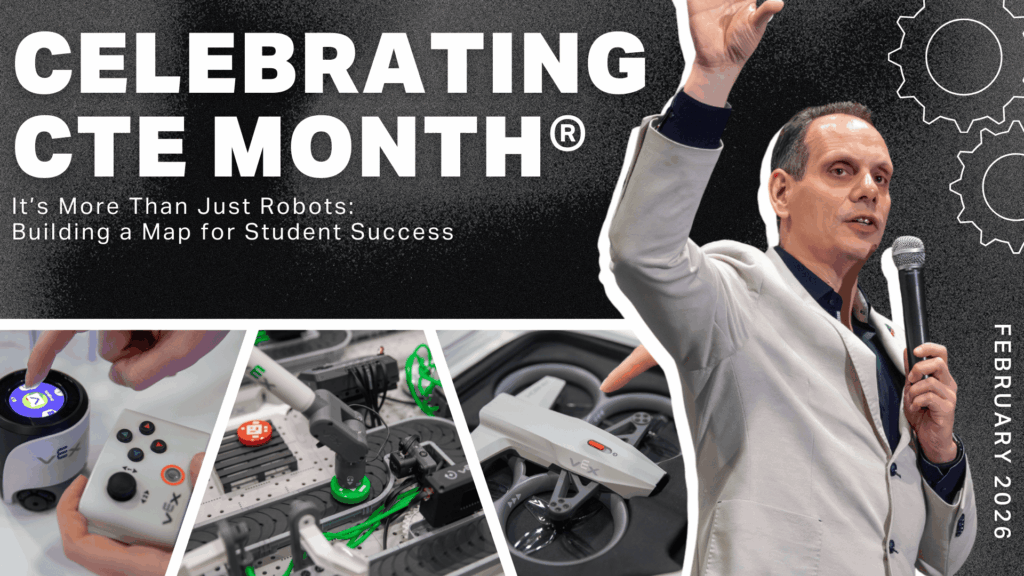
With National Career and Technical Education (CTE) Month taking place this February, VEX Robotics VP of Global Educational Strategy, Jason McKenna, spoke on the importance of CTE at ACTE’s CareerTech VISION 2025 in Nashville, specifically about the necessity of defined student pathways.
McKenna emphasizes the strategic significance of CTE in simplifying the transition from the classroom to the workforce. While student engagement serves as the entry point, the ultimate goal is to provide a structured road map for future success.
“I think career and technical education is really important because we want to make sure kids understand that they have multiple pathways towards a career and multiple pathways towards success,” McKenna said. “And they don’t have to figure this out on their own”.
McKenna highlighted that effective CTE programs act as a guide rather than a rigorous test of independent discovery. By removing the guesswork, educators can allow students to focus on skill acquisition rather than navigational uncertainty.
“They can have a very guided and scaffolded pathway that takes them there,” McKenna said. “And if they see themselves in a particular career, they understand what they have to do to engage with that… and how they can get there”.
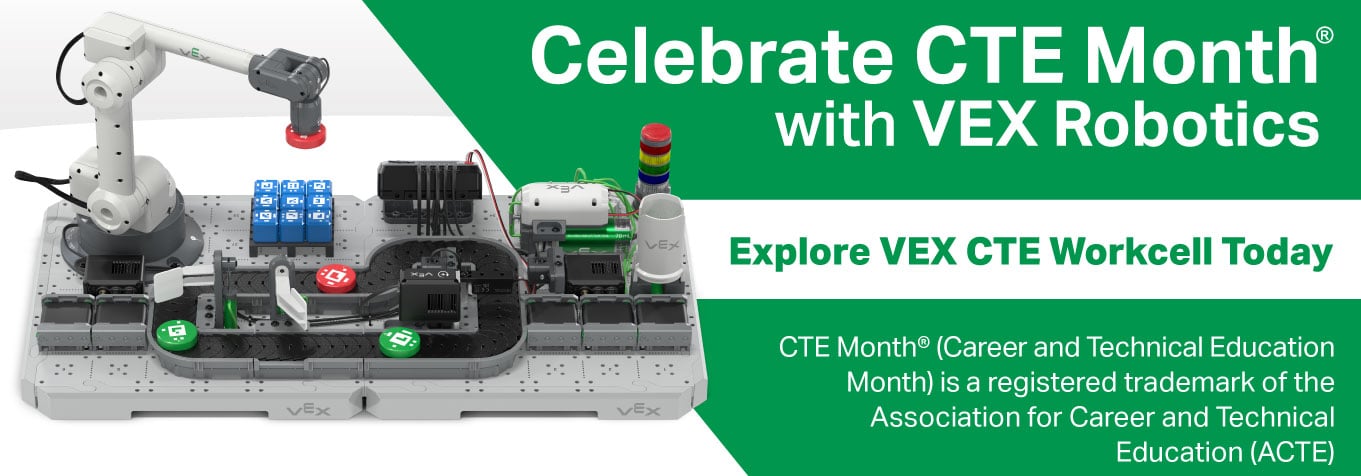
CTE programs can leverage the VEX CTE Workcell to convert theoretical workflows into active simulations. The system features a 6-axis arm, conveyors and pneumatics to run students through essential manufacturing drills like sorting and material flow. By utilizing VEXcode and guided courses, the Workcell provides the tangible equipment needed to execute the scaffolded pathways McKenna described.
While acknowledging that student interests are fluid, McKenna stressed that the value lies in the clarity of the vision provided by these programs.
“They can decide to… change [career] paths…,” McKenna said. “And there’s nothing wrong with that. But I think giving them a clear vision of what they can do and what they can accomplish is important”.
VEX Robotics will continue to champion these initiatives throughout February as part of the nationwide CTE Month observance, focusing on products that maintain both high engagement and educational rigor.
CTE Month® (Career and Technical Education Month) is a registered trademark of the Association for Career and Technical Education (ACTE).
VEX Engineering Team Member and Game Designer Kahl Breaks Down Mid-Season Adjustments for World Championship Push
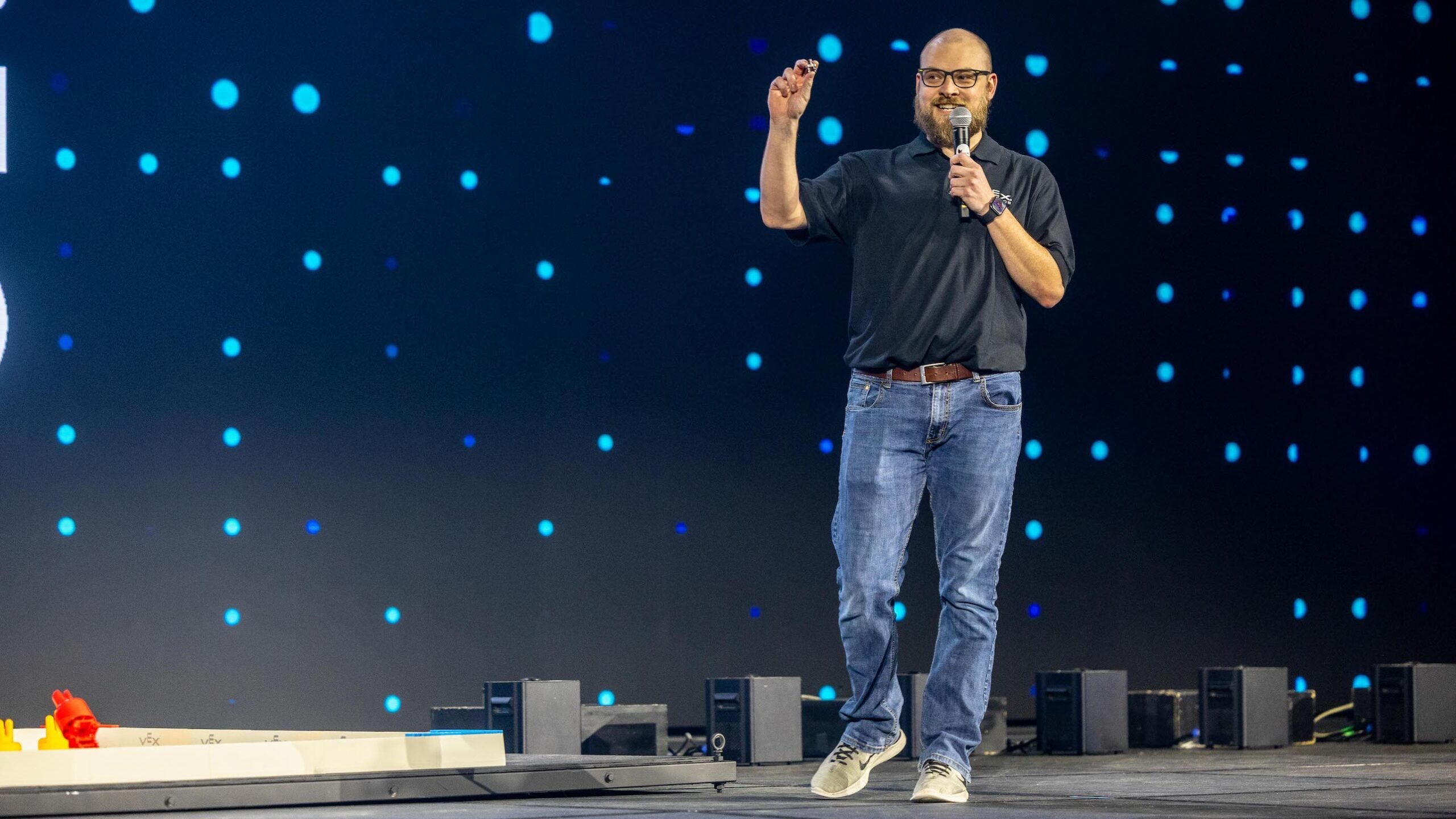
As the 2025-2026 VEX Robotics Competition season approaches its halfway point, elite teams are shifting their focus from initial prototyping to the refined engineering required to secure a spot in the 2026 VEX Robotics World Championship. With the “Push Back” (VEX V5 Robotics Competition) and “Mix & Match” (VEX IQ Robotics Competition) seasons in full swing, engineering team member and Game Designer Bailey Kahl offered a technical scouting report this week, breaking down the hardware optimizations and design philosophies that can help take teams to the top.
Kahl addressed the current state of the VEX V5 Robotics Competition “Push Back” meta, noting the increasing convergence of robot designs. While teams often strive to replicate successful builds, Kahl underscored that judges value not only a functional robot but also the students’ ability to articulate the engineering journey.
“If you only understand the final revision of a design, it’s most likely you can’t describe why it works, because you don’t understand why the previous revisions didn’t work,” Kahl said.
For those looking to distinguish themselves, Kahl advised that the strongest teams are those that can verbally reiterate their design process. By citing specific mechanisms, discussing findings, and displaying clearly defined alterations, teams demonstrate the engineering depth required to compete at the highest level rather than simply fielding a copy of a winning machine.
On the hardware front, Kahl provided a deep dive into VEX V5 Smart Motor management, a critical factor for reliability during deep tournament runs. One key suggestion is to operate under “Velocity” control, which smooths acceleration and ramps up speed to protect internal components. Kahl said that this option is different from “Voltage” control, which requires the motor to go from “0 to 100 mph” right away and offers less protection. Teams were also cautioned against “Brake Mode,” which intentionally stalls the motor to hold position. Kahl noted this practice generates significant heat and can quickly trip thermal limits in high-stress matches.
In the VEX IQ Robotics Competition “Mix & Match” division, the integration of pneumatics remains a key variable. Kahl clarified that the system is designed to inherently leak air as a safety measure, forcing young engineers to be precise with their build quality. To avoid performance loss, teams should make sure that tubing cuts are perfectly straight and that there is enough slack for moving parts like arms or elevators to avoid getting stuck.
Looking for immediate performance gains in autonomous routines, Kahl pointed to the Color Signature feature of the AI Vision Sensor as “low-hanging fruit.” By calibrating the camera to a colored object and creating a simple filter for hue and saturation, teams can create up to seven color signatures simultaneously. This setup provides a strategic advantage in a game that requires rapid multi-color recognition.
As the season heads toward its conclusion, Kahl offered a glimpse into a theoretical “dream rig” for the current “Push Back” game. Prioritizing agility over raw power, this design would ideally feature an omnidirectional drivetrain capable of collapsing under long goals to avoid defensive pushing matches entirely.
Kahl said, “It may not be the best robot on the field, but it will look cool weaving in and out.”
Teams will continue their push for state and regional titles through the spring, aiming to secure their place at the 2026 VEX Robotics World Championship in St. Louis, Missouri this April.
Share this on social media:

The 2026 Reset: 3 Small Changes to Reduce Stress in Your Classroom

As schools start tackling their spring semester, VEX Professional Development Plus has issued a new set of “New Year’s Resolutions” aimed at tightening classroom mechanics and improving student outcomes.
The article encourages educators to use the new year as a “reset button” for their STEM labs and competition teams. The primary directive? Stop touching the robot.
Resolution 1: Transfer Ownership to the Roster: Step Back to Step Up. It’s hard to watch a student struggle with a coding error, but that’s where the learning lives. This year, let’s trade the “Fixer” hat for the “Facilitator” hat.
Resolution 2: Tighten Up “Facility Management”: Clean Workspace, Clear Mind. A messy bin is a momentum killer. Spend a week getting organized so your team can spend more time winning and less time hunting for a 2-inch standoff.
Resolution 3: Value the Process Over the Scoreboard: Finally, the insights article urges educators to refocus on documentation. Sometimes, we tend to overlook the engineering notebook in the rush of preparing for competitions or finishing a unit. VEX PD+ stresses that the documentation is the product. Teachers are encouraged to celebrate the design iterations and the written record of the journey as much as the final robot performance.
By implementing these three adjustments, educators can ensure their programs finish the 2025-2026 school year with strong momentum and measurable student growth.
Share this on social media:

Thank you for being part of the VEX Community! As we dive into the second half of the season and the academic year, we are inspired by the dedication of educators, mentors, and students alike. We look forward to seeing the incredible innovations you create in 2026.
Take a look back at last month’s article: