


Welcome back to Drive Forward News! In this issue: how students from 40+ countries built trust across language and culture at the 2026 VEX Robotics World Championship; a Pittsburgh School district quietly turning VEX GO into a road to The VEX Robotics World Championship; and everything you need to know about the new 55-watt drivetrain rule, straight from longtime competitor and VEX Forum manager Dillon “DRow” Row. With two new Insights articles this month featuring a global educator network and a fresh take on classroom coding bugs, there’s plenty here to carry you through the summer.
Jump to an article to read:
- The Universal Language of Gears
- Woodland Hills School District VEX GO Competition
- Your Drivetrain, V5 Motors, and How to Build Smarter This Season
- VEX Passport: Connecting STEM Educators Around the World
- Build, Break, Learn: Helping Students See Bugs as Powerful Learning Tools
The Universal Language of Gears
By Connor Bourque
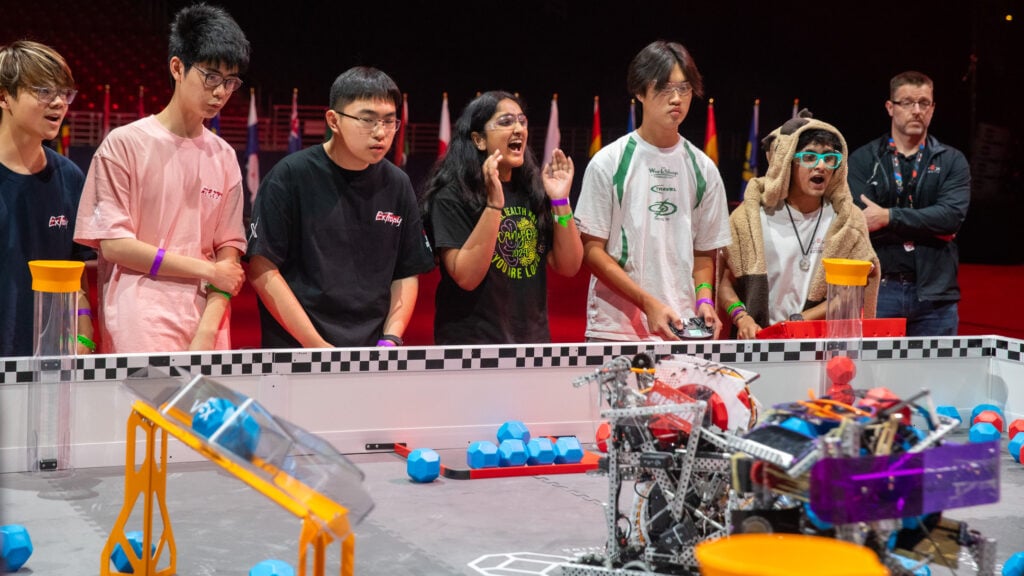
Thousands of students from across the globe converge on a single arena, representing dozens of nations and a kaleidoscope of languages. For these young innovators, the challenge is not just the complex engineering of their robots but the high-stakes, two-minute window they have to forge an absolute, unbreakable trust with a total stranger. This is the heart of the VEX Robotics Competition—an international showcase of ingenuity where collaboration is not just encouraged but required. While Merriam-Webster defines teamwork as “work done by a group acting together so that each member does a part that contributes to the efficiency of the whole,” the reality on the field is often more complex. Given the importance of this synergy, how does a team from Barbados effectively unite with a team from Japan to achieve a shared victory, particularly in an era when global collaboration often feels sometimes as if it is on the decline?
Robert D. Putnam, Ph.D. distinguished between building connections with those from a similar culture and building bridges across different social groups. Bonding capital is the social capital associated with making connections with similar cultural or social groups, whereas bridging capital is making connections with those from other cultures or social groups. Bridging capital is the backbone of international collaboration. While these observations are specifically about social life, not workplace teamwork; social norms lay the foundation for how professionals operate in the workplace or academic setting.
The 2026 VEX World Championship in St. Louis, MO, saw over 2,000 teams from over 40 different countries. A key part of any VEX Robotics Competition tournament involves each VEX V5 or VEX IQ team being paired with another to form an ‘Alliance.’ They’ll then need to communicate effectively before and during the match to be successful. Situations like these should be prime real estate for miscommunication due to cultural communication differences. So how is it that two teams from two different cultures of communication can effectively work together in a high-pressure, competitive environment, such as the VEX Robotics World Championship?
Cross-cultural communication and teamwork, two topics that Robert D. Putnam, Ph.D., Edward T. Hall, and Markus G. Kittler et al. suggest are in decline or that can be difficult, seem to have flourished at the 2026 VEX World Championship. While a robotics competition is fun and competitive, it also emulates a classroom environment, like what a member of V5RC Middle School Team 38657X PotayTech from Thailand said, “There are so many different people from different countries coming together… we get to see how they approach problems… and we learn from these experiences.” When asked about what they learned from working with other teams from other countries with a language barrier, a member of V5RC High School Team 4898A Pioneer Flamingos from Hardwick, MA said, “We established hand signals beforehand, so that is instrumental in our communication.” Using hand signals to communicate between teams helps create bridging capital when facing both language and cultural communication barriers. Likewise, a team member of V5RC High School Team 24611B Gears N Bots from Bridgetown, Barbados, said that they used a similar system to communicate with their alliance, saying, “We were still able to get through with little hand gestures… or Google Translate… because we’re all here for the same thing: the love of our robots, the love of the game.” Participants in the VEX Robotics Competition acknowledge the cultural communication bridge and have found a seemingly simple yet effective way to close that gap. A team member for Team 3453D Kente Coders from Accra, Ghana, summed this up with, “Sometimes even though you have a language barrier, you still have to find a way to talk to them. That’s what I like about the competition.” Many participants that our team interacted with in the VEX Robotics Competition agree with this statement.
Ultimately, the VEX Robotics World Championship serves as more than just a battle of engineering prowess; it is a global experiment in human connection. When the buzzer sounds and two teams from opposite sides of the globe unite on the field, the intricate nuances of language and cultural context fall away. In their place emerges a new, shared dialect—one written in hand signals, strategic nods, and the relentless, mechanical hum of robots. By choosing to prioritize collaboration over communication, these young innovators prove that the “universal language” of robotics is a powerful bridge. It is a reminder that when individuals are united by a common passion, they can overcome even the most formidable barriers, transforming a simple game into a profound lesson in global unity.

Woodland Hills School District VEX GO Competition
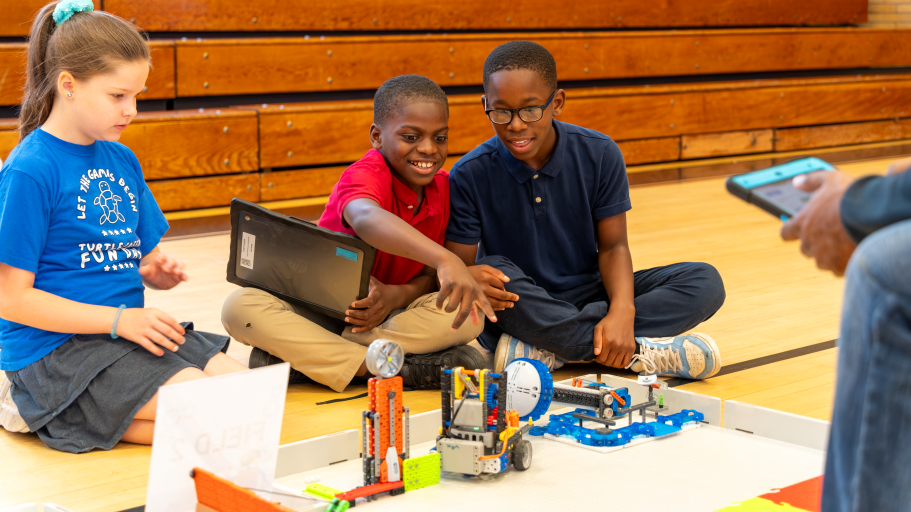
Towards the end of the school year, most classrooms are running out the clock. At Turtle Creek Elementary STEAM Academy in Pittsburgh’s Woodland Hills School District, the fourth graders are doing something else entirely. They are piloting and coding small robots across a half-built village, racing to move water pipes and raise the water tower before the buzzer. The gym hums with motors and the noise of kids who have waited weeks for this. In the stands, classmates run virtual practice rounds and cheer. Down on the floor, teammates lean over the field, reset game pieces, and try one more time to lift the tower upright.
This is the Woodland Hills VEX GO Competition, now in roughly its fifth year. Every third, fourth, and fifth grader at the district’s three elementary STEAM academies, Turtle Creek, Wilkins, and Edgewood, competes against their peers. Across three days, one grade level at a time, about seventy-five teams take the field. Not many know that VEX GO has a competition. What happens in this gym is something a district simply decided to build for its kids. Yet for many, this is their first step into the much larger world of the VEX Robotics Competition.
“This is how the kids first got their taste of competitive robotics,” says Jason McKenna, Vice President of Global Educational Strategy for VEX Robotics, who travels to Woodland Hills for the event each year. What makes it work, he notes, is that this is not an after-school club for a handful of robotics kids. Every student in grades three through five touches VEX Robotics, because the district has woven it into the regular science curriculum for years.
That integration is the work of Tina Dietrich, the district’s Director of STEAM and Innovation, who built VEX Robotics into the school day and has run the VEX GO competition since its early days. Sixth grader Kyra Scott remembers when it started. “My teacher, Ms. Dietrich, she started the VEX program… and they slowly started incorporating it into our daily routines,” she says. “That’s when I started learning how to build small things before learning how to actually do big things.”
Preparing seventy-five teams is a significant challenge. For six to eight weeks, essentially since state testing ended, teachers prepared their students, often without a full competition field to practice on. They improvised with partial fields, virtual skills rounds, and borrowed classrooms. The result, McKenna notes, is a roomful of kids doing collaborative problem-solving and coding at exactly the point in the year when he, as a former teacher, admits he “was showing movies.”
The clearest proof that VEX GO is a launchpad is who runs it. The matches are judged, scored, and timed by some of Woodland Hills’ own VEX IQ middle school team, students who started right here. Spencer, now on that team, helped time the matches. He has already been where these fourth graders dream of going. At the VEX Robotics World Championship, his team worked to communicate with teams from China. His advice for the little kids is simple: “There’s no bad ideas in brainstorming… always have fun.”
Another member of the aforementioned VEX IQ team, Kyra, served as a judge, helping younger kids the way older students once helped her. Next to her is her father, Carlton Scott, who has worked the elementary competition nearly every year. He understands the long-term view. “Ultimately when the academics catch up with the actual robotics… you’re going to have students that are going to be taking this to college and beyond.” But the intangibles come first, the teamwork and learning to sit with both disappointment and success. “Just finishing third is, like, a great thing for them.”
The kids feel all of it. Suia, the 2026 Woodlands Hills VEX GO Competition Champion for fourth grade, built and coded largely on her own after teammates didn’t show and shook through the semifinals, and won anyway, a year after scoring no points at all. “VEX is hard. It has ups and downs,” she said. “You shouldn’t stop trying.” Arrin, a fourth-grade transfer student, came in last his first year. “That’s okay, because we can always keep trying.”
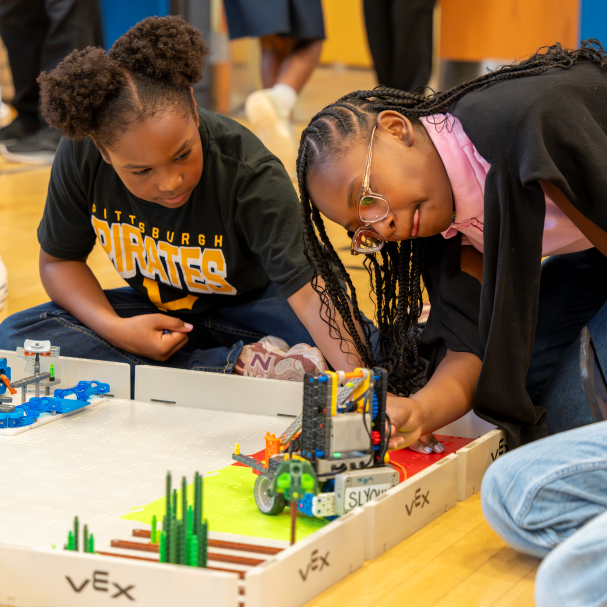
Karen Lyons, the school board president and grandmother of an Edgewood student, came to watch and left feeling moved. She marveled at the students’ engineering notebooks, where “adults can’t do what they have done,” and at how fiercely competitive these kids could be while still acting like a team. “Who gets to go to a world championship?” she asked. “Our kids are doing that.”
She is right, and the path is real. Woodland Hills has sent VEX IQ teams to the VEX Robotics World Championship two years running; growth McKenna ties directly to the exposure kids get through the VEX GO competition. From here, students step up to the officially sanctioned VEX IQ Robotics Competition, then to VEX V5, with the road now running through the Global Robotics and Science Foundation and events.vex.com.
It all started in a gym in Pittsburgh, where a district decided every third, fourth, and fifth grader deserved a turn at the field. And from that decision, one water pipe and one water tower at a time, a generation of robotics students and competitors is being built. The robots here are small. What they start is not.
Your Drivetrain, V5 Motors, and How to Build Smarter This Season
Are we in pre-season? Sort of. When you think about VEX Robotics globally, everyone’s season is different. Here at VEX Robotics Headquarters in Texas, summer has definitely set in, and it’s a good moment to talk about what’s changed under the hood for V5 teams this year.
The short version: there’s a new drivetrain rule, and it changes how you think about every motor on your robot.
The Rule That Changes Things This Season
In past seasons, the only constraint was an 88-watt total: eight 11-watt motors, allocate them however you want. All eight can go on the drivetrain if you want. Two on the drivetrain, six elsewhere. Teams had full latitude. A few seasons ago, the GDC added 5.5W motors to the list of legal parts, meaning you could get even more creative with motor allocation, even going to the extreme of using sixteen 5.5W motors if you wished.
This season, a new twist was added to the motor rules. The GDC introduced a 55-watt maximum on the drivetrain. Your total motor allocation is still 88 watts across the entire robot, the drivetrain just has its own limit. The remaining 33 watts go wherever you need them. But the drivetrain is now capped.
To make sense of it, we spoke with Dillon “DRow” Row, a longtime competitor and mentor who now runs the VEX Forum, which means he’s seen more robot builds and drivetrain debates than almost anyone.
“In the past there was no limit on how you could allocate your motors,” DRow explains. “But this year we put in the limits, saying you could only use 55 watts as a max on the drivetrain.”
He sees it as a return to something fundamental: a level playing field. “It kind of goes back to where everyone’s on that same level ground. No matter what, you can’t go over that 55-watt limit.”
Drivetrains are important, but Dillon noted that the VEX Game Design Committee had begun to take notice that teams were sacrificing scoring mechanism performance in order to ensure they had 66W of motor power in their drivetrain to keep up with the rest of the competition. He said “The Game Design Committee explained it to me as an attempt to re-shift the ‘norm’ towards allowing more flexibility in how teams approach planning motor allocation.”
The Two Motors You’re Working With
The motors are the main focus here, because the new wattage cap makes motor choice a real build decision.
If you’ve been in V5 for a while, you know the V5 Smart Motor, the 11-watt motor that launched with the V5 system. Three interchangeable gear cartridges, reliable and proven. It’s been the standard.
The 5.5-watt motor is newer. It came out alongside VEX EXP and is exactly half the power of its bigger sibling. Teams wanted it available for V5 (it was already compatible with the system), so the Game Design Committee made it legal a few seasons ago. Many teams have proven its value, demonstrating its use across various mechanism types, including intakes, conveyors, and more.
“It’s the same motor, just a little bit smaller footprint and half the power,” DRow says. “You can fit them in more places. It just gives you a little bit more flexibility.
The smaller motor isn’t a downgrade; it’s a different tool. More torque or speed on a demanding mechanism? You want the 11-watt. Something that spins slow and doesn’t need muscle? The 5.5-watt one fits the bill and frees up wattage for somewhere that needs it more.
How to Actually Think About Motor Allocation
With 55 watts as your drivetrain ceiling, how you get there is the build decision. A few ways that math works out:
- Four 11-watt motors on the drivetrain — 44W
- Five 11-watt motors — 55W, right at the limit
- A mix of 11-watt and 5.5-watt motors to reach the number a different way
DRow’s advice to teams at every level is the same: experiment.
“Try different ways you allocate it for your drivetrain. Whether you do two of the 11-watt motors on each side — so four total — or you could do six of the 5.5-watt motors. Try those different combinations, because the way you get to 55 watts is totally up to you.”
He’s deliberate about not prescribing a single answer, and for good reason. “What might work for you might not be best for another team. So just because someone on the internet says this works, their robot might be entirely different than yours. Play with it and see what works for you, your team, your strategy, your style of play.”
The 5.5-watt motor’s plug-and-play compatibility makes this kind of testing practical. Swap it in, run it, and see what happens. The decision comes from the robot in front of you, not a forum thread.
The restriction in the drivetrain also opens up possibilities to use that last 11W of motor power elsewhere on a robot. In a game like Override, where object manipulation is so critical, an extra degree of freedom may go a long way. It is DRow’s hope that this adjustment creates more opportunity for creative design, stating “Over the course of a season, teams naturally converge towards a few select designs. With more motors to create mechanisms, there is more of an opportunity for unique designs and implementations, allowing students to really show off their creations.”
What Actually Makes the Difference
Success in VEX looks different for every team. For some it’s a trip to Worlds; for plenty of others it’s making it through qualifiers or simply having a robot that holds together and does what it was built to do. Wherever you land on that spectrum, the same principle applies, and when the conversation turns to what separates a good day from a frustrating one, DRow doesn’t start with motors.
He says, “A good built robot can beat a team that builds a bad robot any day of the week. If that robot falls apart during a match, even with the best strategy, you’re not going to win. A team that has a consistent robot—one that always does what they expect it to do, nine times out of ten—will usually win. Just because they know what’s going to happen.”
Consistency over cleverness. That’s the frame. Motors are one variable inside that larger build philosophy, not a shortcut around it.
To that end, Dillon was sure to state that “This change is less impactful than many teams think, and robot building tactics will remain much the same.” He went on to reiterate that motor power doesn’t win matches; build quality and ingenuity, combined with proper strategy and competent software propel teams forward.
He closed with a resting message of “Losing a motor in your drivetrain is not going to lose you a match.”
For the Teams Just Getting Started
DRow spent years talking to teachers at trade shows, first-timers trying to understand what they were walking into. His message never changed.
“More than likely you’re going to get your butt kicked the first competition you go to. That’s just the nature of it. You’re competing against teams that have been doing this sport for years. But don’t be afraid. You’ll get better over time.”
And if you don’t know something, ask. “99 times out of 100, if you ask someone a question, they’ll be more than happy to answer it and give you advice on what worked for them. Just be inquisitive. Keep learning.”
One word for the community? DRow doesn’t hesitate: “Family.”
He continues, “Most people are super welcoming. We’re all here for the same reason—just to get to play with robots all day. We’re all in this together, trying to learn and make the future leaders.”
Both Motors are Available Now
If you want to try the combinations DRow describes (a full 11-watt on a high-torque mechanism or 5.5-watt motors tucked into tighter spaces) both are available:
Dillon “DRow” Row last competed in VEX Robotics in 2011 as part of the Robo Wranglers and mentored the team through 2022. He currently manages the VEX Forum.

VEX Passport: Connecting STEM Educators Around the World
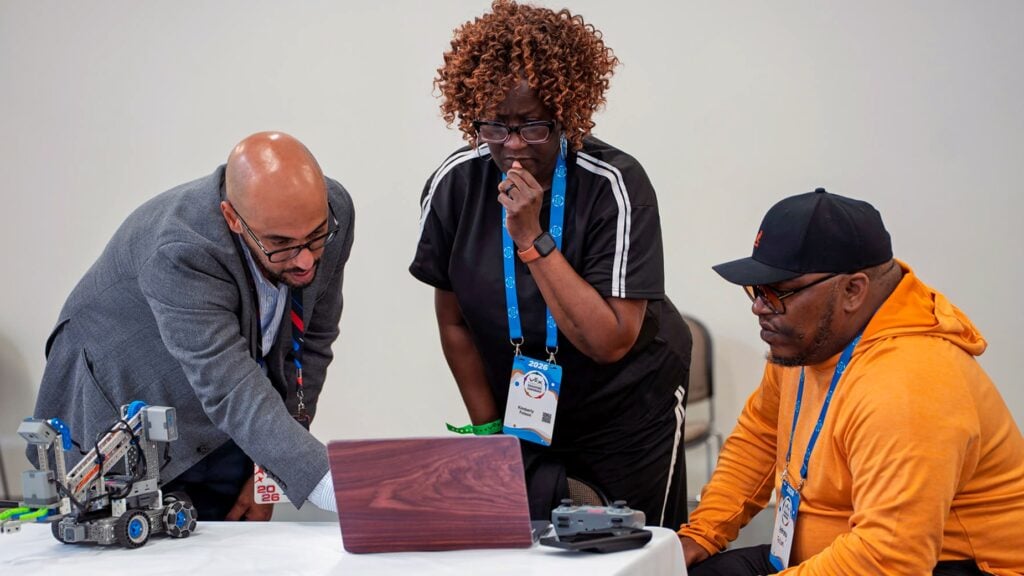
In this Insights article, Sr. Educational Developer Aimee DeFoe introduces VEX Passport, a feature within PD+ designed to pull certified VEX educators out of professional isolation and into a worldwide community. It opens with a nice parallel: just as students from different countries become collaborators and friends at the VEX World Championships, VEX Passport brings that same spirit into everyday teaching, a lifeline for the teacher who’s the only one doing robotics in their building, the STEM coordinator without a nearby peer, or the administrator trying to understand STEM in practice.
Practically, it works through an interactive map inside PD+ where educators can see where others are located, search by location or platform, and connect through the PD+ Community when permissions are enabled, turning certification from a solo accomplishment into a doorway to a global learning network (a teacher using VEX IQ in Pennsylvania linking up with one in Brazil, a principal in Ottawa exploring how VEX is used in Nairobi). Getting started is simple. Review your profile and connection settings, then explore the map. The piece closes on a bigger idea: in an age when answers are simple to produce, understanding different perspectives matters more than ever, and VEX Passport is an invitation to treat STEM teaching as shared work, a reminder that even a solo robotics teacher is never really alone.
Read here.
Explore the VEX Passport here.
Build, Break, Learn: Helping Students See Bugs as Powerful Learning Tools
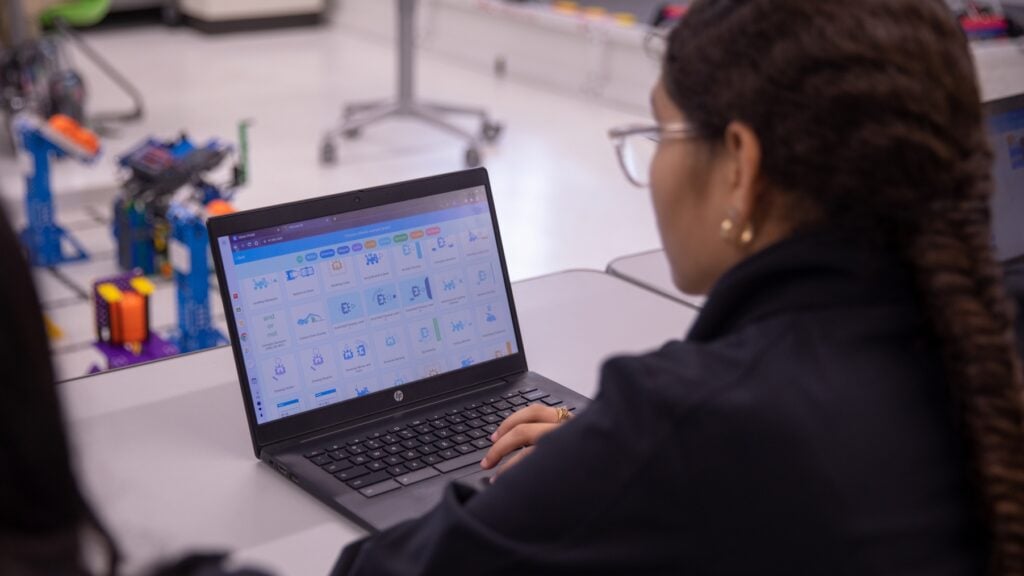
Sr. Educational Developer Aimee DeFoe argues, in a recent Insights article, that coding bugs shouldn’t be rushed past as failures but embraced as some of the richest learning moments a project offers. Drawing on research from Yasmin Kafai and Deborah Fields, it makes the case that reframing debugging as a teachable, even enjoyable, skill builds students’ resilience, reasoning, and independence and that jumping in with the fix too quickly robs them of that growth. It then gets practical, offering a three-question debugging routine (what should it do, how is it trying, where does it go wrong?), tools in VEXcode like the Step Button and block highlighting, and a set of “buckets” for sorting bugs (sequence, logic, configuration, hardware). It closes with its most powerful idea: having students intentionally design their own bugs to swap and solve, which both deepens understanding and drains the fear out of mistakes, turning the classroom into a place where errors are expected, examined, and even celebrated.
Read here.
Thanks for reading!
Take a look back at our last issue’s articles:
- 2026 VEX Robotics World Championship: A Community Celebration
- VEX Robotics Educators Conference Spotlight
- VEX Robotics Reaches MOU in Belize
- New My Robotics Journey Episode Featuring Kathy Cepo & Michelle Massaro
- After the VEX Robotics World Championship: We’re Heading to ISTELive 2026
- Empower Your Students Beyond the Classroom with VEX Extended Learning
- Explore Extended Learning directly here: https://camps.vex.com/